
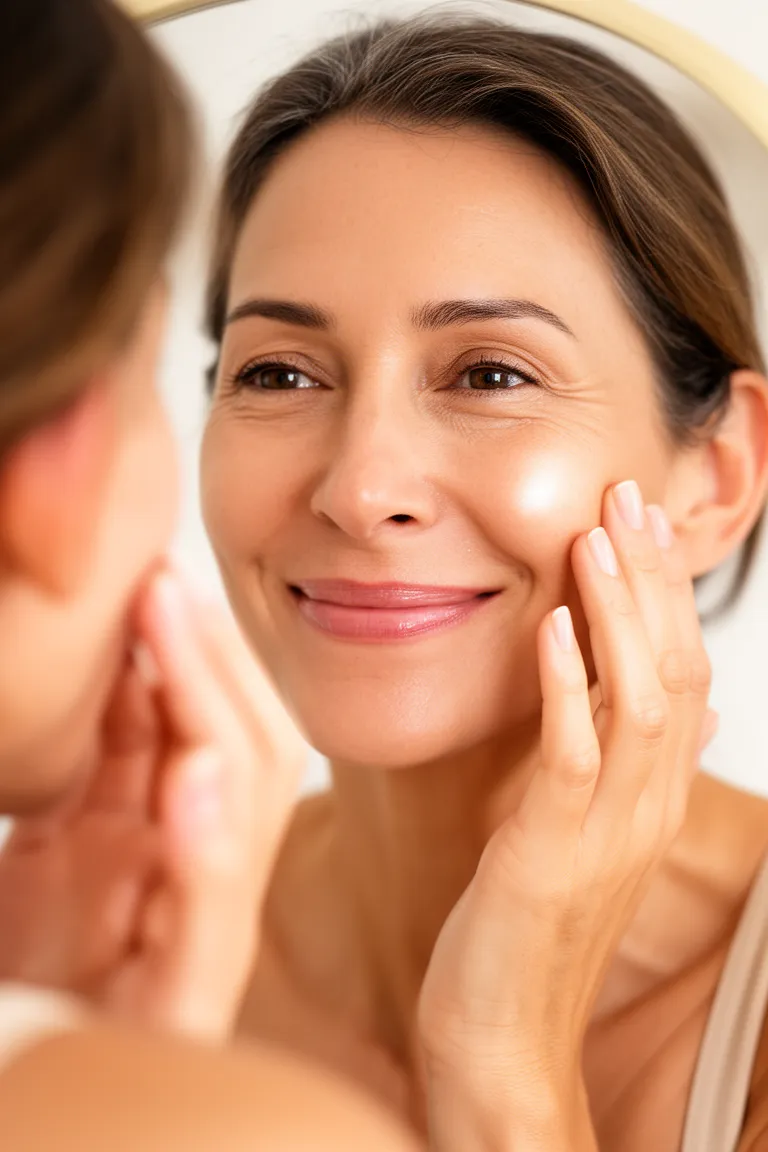
I’d always been the responsible one. My medicine cabinet wasn't a graveyard of half-used impulse buys; it was a curated library of SPF 50, gentle cleansers, and antioxidant serums. I ate my leafy greens, drank my water, and never, ever went to bed without removing my makeup. So, when I first noticed that subtle, soft droop along my jawline in my late forties—a softening that no amount of product seemed to snap back—my first emotion wasn't sadness. It was pure, unadulterated frustration. I felt cheated. I’d followed the rules. I’d done everything right. And yet, my skin was quietly, defiantly, losing its elasticity after 40.
It started in the unforgiving light of my car’s visor mirror. The contours of my cheeks, once defined, seemed to have a gentle, downward pull. My neck, which I’d admittedly neglected compared to my face, began to show a crepey texture that my trusty moisturizer couldn’t smooth away. I doubled down, of course. I bought the expensive firming creams with the luxurious packaging and bold promises of “instant lift.” I layered serums upon serums, hoping the next one would be the miracle. The results were subtle at best—a temporary plumpness that faded by noon, leaving me with the same familiar silhouette and a lighter wallet. That’s when I realized I wasn’t just fighting gravity; I was fighting a fundamental misunderstanding of what it actually means to restore skin elasticity after 40 when your usual skincare stops delivering.
This is the story of my shift from chasing quick fixes to building a routine that finally worked with my skin, not against it. It’s for anyone who’s looked in the mirror and wondered, “Why isn’t my firming cream working after 40?” You’re not doing it wrong. The game has simply changed.
The Morning I Realized My Usual Routine Wasn’t Restoring Skin Elasticity After 40
It was a Tuesday. I was applying my tinted moisturizer, using my usual upward strokes, when my fingers registered a difference. The skin over my cheekbones didn’t have the same resilient bounce. It felt softer, less anchored, like a cushion that had lost some of its stuffing. In photos from a weekend gathering, my smile looked slightly different—not worse, but the definition along my jaw was softer, blurrier, as if someone had gently smudged the edges. This wasn’t about wrinkles or fine lines, which I’d made peace with. This was about architecture. The scaffolding was shifting. The disciplined, preventative routine I’d sworn by for decades—the one that had fended off sunspots and kept my skin relatively clear—was now feeling like it was just maintaining a holding pattern, not addressing this new, deeper change. My skin was losing elasticity after 40 even though I used sunscreen and lived a healthy life. The rulebook I’d relied on needed a serious revision. That feeling of being cheated by my own good habits was the spark that sent me down a new path.
What Actually Changes in Skin Elasticity After 40
My journey to understanding began with a humbling dose of biology. I had to move past the marketing and learn what was happening beneath the surface. It turns out, the shift isn't a personal failing; it's a predictable, physiological transition. First, our collagen production takes a nosedive. Think of collagen as the mattress springs of your skin—they provide the structural support and snap-back. After 40, we break down more collagen than we make, and the existing fibers become weaker and more disorganized. Elastin, the protein that gives skin its stretch and recoil, also degrades and loses its functionality, like an old rubber band that’s lost its stretch. But here’s the kicker that connected the dots for me: it’s not just production slowing down. The skin’s renewal process (cell turnover) gets sluggish, leading to a buildup of lackluster surface cells that can make skin look dull and emphasize any underlying looseness. Natural oil production decreases, so skin gets drier and fine lines appear more pronounced, making any loss of underlying support more visible. And all that cumulative sun exposure from my youth, despite my later-day sunscreen vigilance, was finally presenting its bill through something called photoaging, which breaks down collagen and elastin at an accelerated rate. Finally, hormonal changes, especially for women, play a massive role. Dropping estrogen levels directly impact collagen production and skin thickness. Learning this didn’t fix the problem, but it freed me from the blame. This wasn't a skincare routine flaw; it was a life stage. My skin wasn’t betraying me; it was simply evolving, and my care needed to evolve with it. [Functional integrity of aging skin, from cutaneous biology to anti-aging...
Why My Firming Creams Didn’t Lift My Skin
Armed with this new knowledge, I looked at my collection of “lifting” and “firming” products with fresh eyes. I had been expecting them to perform a mechanical miracle—to somehow grab my skin and hoist it back up like a pulley system. The truth was far less dramatic, and understanding it saved me a fortune. Most firming creams work primarily through hydration and surface-level plumping. Ingredients like hyaluronic acid and glycerin draw water into the outer layer of skin, temporarily swelling it and making lines and laxity look improved. It’s a beautiful, but fleeting, illusion. By midday, as that water evaporates or is metabolized, the skin returns to its baseline. I was essentially paying for a temporary optical effect, not a structural repair. Some creams contain peptides or growth factors that may, over a long period, support collagen production. The key word is support. They are not building new scaffolding overnight. They are sending gentle signals to your skin’s fibroblasts (the collagen-making cells) to maybe get back to work. The results are subtle, incremental, and often take months to become visible. I realized I had been judging these products on a “next-day lift” scale, when their actual benefits were playing out on a “three-month subtle improvement” timeline. It was a classic case of mismatched expectations. I was asking a hydrating serum to do a structural engineer’s job. This was the core of my frustration: I tried everything to restore skin elasticity after 40, but I was using the wrong tools for the task.
The Turning Point: Redefining "Restore"
This was my pivotal moment. To restore skin elasticity after 40, I had to stop thinking about “restoring” as “reversing” or “going back.” That ship had sailed. Instead, I began to think of it as “reinforcing,” “supporting,” and “optimizing” what I still had. My goal shifted from seeking a lifted look to building resilient, thick, well-hydrated skin that looked its healthiest at this age. This mindset change was everything. It took the panic out of the process and replaced it with purposeful, strategic action. It meant focusing on ingredients proven to influence skin biology, not just its temporary appearance. I stopped asking, “Does this make me look tighter right now?” and started asking, “Is this helping my skin become stronger from within?” That shift in perspective was the real game-changer.
The Routine I Built Instead: SPF, Retinoids, Hydration, and Patience
I simplified dramatically. Out went the pile of miracle-promising potions. In came a targeted, consistent lineup focused on evidence-based action. This became my best routine for skin elasticity after 40 when nothing works.
The Non-Negotiable Foundation: SPF. My daily broad-spectrum SPF 50 became my most sacred skincare step. Not just for prevention, but because any active ingredients I used to support collagen would be undermined without it. Sun exposure is the ultimate collagen destroyer. This wasn’t just prevention anymore; it was active treatment. Every morning, rain or shine, it went on after my serum and before my moisturizer. No exceptions.
The Gold Standard Active: A Retinoid. I introduced a prescription retinoid (after a consult with my dermatologist) very, very slowly. I’m talking once a week, over moisturizer, for a month. Yes, I peeled. Yes, it was irritating at first. But retinoids are one of the few topicals clinically proven to actually boost collagen production over time. They accelerate cell turnover, thicken the deeper layers of skin, and fade sun damage. This became the workhorse of my routine. It required patience I never knew I had, but it delivered changes nothing else ever had. After three months, my skin texture was smoother. After six, I noticed a new firmness when I pressed my cheeks—it had more resistance. This was the retinol and collagen for skin elasticity after 40 honest experience I needed. best dermatologist approved anti wrinkle cream when retinol irritates my face.
Intelligent Hydration. Instead of just slathering on cream, I focused on layering hydration. A hyaluronic acid serum applied to damp skin, followed by a richer moisturizer with ceramides and peptides to lock it all in and support the skin barrier. Plump, well-hydrated skin simply looks firmer and more youthful, and a strong barrier is essential for tolerating actives like retinoids. I tried collagen boosting skincare products and my skin still looks tired.
Internal Support. I started taking a collagen peptide supplement after reviewing the research. I also doubled down on vitamin C-rich foods and protein intake. Did it work? The science is still evolving, but anecdotally, my nails got stronger and my skin’s hydration seemed to improve from within. I viewed it as foundational support, not a magic bullet, part of my exploration of how to improve skin elasticity after 40 naturally.
Scientific Evidence
Mapping Your Pathway: A Realistic Comparison
As I navigated my options, I wished someone had laid out the different pathways clearly—not as a hierarchy of good vs. bad, but as a spectrum of commitment and potential results. Here’s the comparison that would have helped me understand where to start and what to expect.
| Approach | Best For | Realistic Timeline for Visible Change | Key Consideration |
|---|---|---|---|
| Enhanced Basics (SPF + Hydration) | Starting point or those with very sensitive skin | 4–8 weeks for improved plumpness & glow | Excellent foundation, but won't significantly rebuild collagen on its own. |
| At-Home Active Focus (Adds Retinoids/Peptides) | My personal journey—committed to consistent daily care | 3–6 months for texture; 6–12 months for firmness | Requires patience, irritation management, and daily SPF. Delivers meaningful, but gradual, improvement. |
| Combined At-Home + Professional Treatments | When high-quality home care plateaus and deeper support is desired | Professional results vary (1–3 months post-treatment); home care continues. | In-office treatments target deeper layers; home care maintains and enhances results. A significant investment in time and resources. |
Seeing it laid out like this helped me understand that my initial frustration came from expecting "At-Home Active" results from an "Enhanced Basics" approach. It also showed me the logical next step if I chose to take it.
When At-Home Care Stopped Being Enough
After about a year of this disciplined routine, I saw real improvement. My skin was brighter, smoother, and had a healthier thickness. But the initial softening along my jaw? It was better, but not gone. The skin was higher quality, but some of the original architecture had shifted. And that’s the honest truth about trying to improve skin elasticity after 40 naturally—you can achieve fantastic improvements in skin quality, but you cannot deeply lift tissue that has lost its structural support with cream alone. This wasn’t a failure; it was a boundary. stretch marks even though I work out and maintain a stable weight.
I reached a plateau, and that was my signal to see a dermatologist for sagging skin after 40. I needed professional insight. She validated my routine, complimented the health of my skin, and then explained the options beyond it: procedures like radiofrequency microneedling or ultrasound therapy that create controlled micro-injuries deep in the dermis, triggering a significant wound-healing response and new collagen production over months. These aren’t quick fixes either, and they’re not surgical lifts, but they work on a level no cream can penetrate. Having that conversation was liberating. It took the pressure off my daily products. They were doing their job beautifully by creating the healthiest canvas possible; now, if I wanted to address specific structural concerns further, I had a new, realistic pathway to consider. It transformed my question from “What cream am I missing?” to “What level of intervention aligns with my goals?”
The Most Important Ingredient: Time
The biggest lesson in my entire experience restoring skin elasticity after 40 was the re-calibration of my timeline. We are conditioned by marketing to expect results in weeks. Skin transformation at this age happens in seasons. It took me six months to truly appreciate the changes from my retinoid. It took a year to feel like my skin had fundamentally improved its health. Letting go of the daily scrutiny and adopting a quarterly check-in mindset was the final, critical piece. I stopped looking for lift every morning and started appreciating resilience, glow, and health. I’d look at old photos and realize my skin now looked more alive than it did even a year ago, even if its position on my face was a gentle evolution of time. That shift in perspective—from fighting my face to caring for it—was, ironically, the most rejuvenating thing of all.
Frequently Asked Questions

Q: How long does it really take to see improvements in skin elasticity after 40? A: This was my hardest lesson. With consistent use of actives like retinoids, you might see improvements in texture and fine lines in 3-4 months. But meaningful changes in firmness and elasticity—the kind you can feel, not just see—often take 6 months to a year of unwavering consistency. It’s a marathon, not a sprint, which is why patience is the most non-negotiable part of the routine.
Q: Am I wasting money on skin tightening creams after 40? A: Not entirely, but you need to manage expectations. These creams are excellent for intense hydration, barrier support, and delivering supportive ingredients over time. View them as essential maintenance and support for your skin’s foundation, not as a substitute for medical-grade actives (like retinoids) or professional procedures for significant lifting. If a cream promises “instant, dramatic lift,” be very skeptical.
Q: What’s the one product I should invest in if I want to improve skin elasticity? A: Without a doubt, a prescription retinoid (like tretinoin) or a high-strength retinol. It is the most researched, proven topical ingredient for actually stimulating collagen production. However, it must be introduced slowly to avoid irritation, and it must be paired with daily, meticulous sunscreen use. If you can only prioritize one “active,” this is it.
Q: When should I consider seeing a professional? A: Consider a dermatologist consultation when you feel your high-quality, consistent at-home routine has plateaued and you’re no longer seeing progress, or when your concerns about laxity are affecting your confidence. A professional can assess your skin’s structure, validate your routine, and discuss in-office options that work at a deeper level than topicals can reach. It’s a great step for getting personalized, realistic advice.
Q: Can you really restore skin elasticity after 40, or just improve it? A: This is the core of the journey. You cannot fully “restore” the elasticity of your 25-year-old skin. But you can dramatically improve the elasticity, thickness, and resilience of your 40+, 50+, or 60+ skin. The goal is the healthiest, strongest, most glowing version of your skin now—not a time machine. That shift in perspective from “restoration” to “optimization” is genuinely empowering.
Q: How do I choose supportive supplements or topicals without getting overwhelmed by brands? A: Look for transparency. For supplements, seek products that list the specific type and amount of collagen peptides (like Verisol® or other studied forms) and have third-party testing for purity. For topicals like retinols, start with a concentration from a reputable brand that discloses the percentage. Remember, the most expensive option isn’t always the most effective. Consistency with a well-formulated product beats an expensive bottle used sporadically.
📌 Love this guide? Save it on Pinterest!
Pin Restore Skin Elasticity After 40: My Honest Journey & What Actually Works 2026 to your board so you can come back to it later.

