
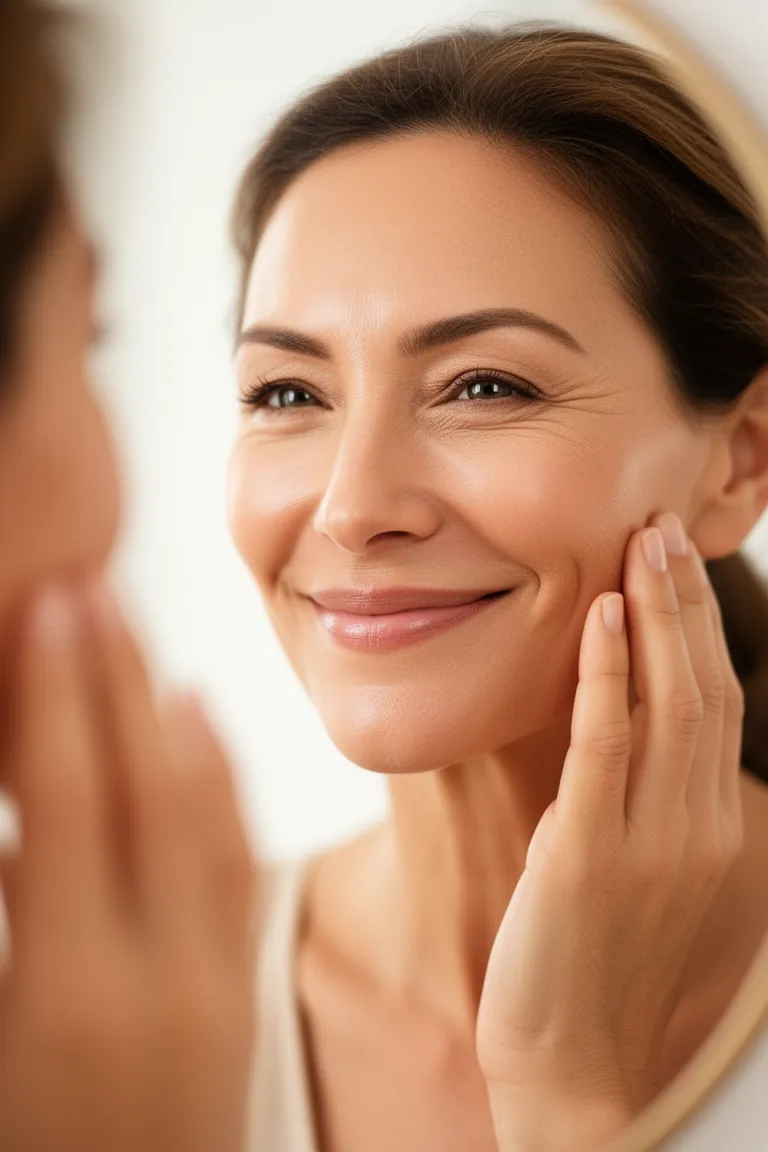
I did everything right. Or so I thought. At 47, my routine was something I was quietly proud of. I ate my leafy greens, drank water like it was my job, moved my body, and slathered on SPF 50 every single morning without fail. I wasn’t chasing perfection; I just wanted my skin to reflect the care I put into it. So, when I started noticing my skin looking less firm, when a smile seemed to linger a little longer on my cheeks before smoothing out, I was genuinely confused. I’d look in the mirror after a shower and think, “But I follow all the rules.” It felt like a betrayal. I’d held up my end of the bargain, and my skin was changing the terms anyway.
The frustration wasn’t about vanity, not really. It was about that unsettling gap between effort and result. I’d invested in expensive firming creams promising to “restore bounce” and collagen supplements that swore they’d rebuild from within. The results were so subtle, so whisper-quiet, that I began to wonder if I was just imagining a difference, or worse, throwing money at a problem that was simply inevitable. I felt stuck between two unhelpful narratives: one that said aging skin was a personal failure, and another that said it was just something to accept with sad resignation. I refused to believe those were my only options.
That stubborn refusal led me down a rabbit hole of research, conversations with dermatologists (the patient, explanatory kind), and a lot of trial and error on my own face. What I discovered changed my entire approach. Restoring skin elasticity after 40 isn’t about finding one miracle product. It’s less a battle and more a long-term, gentle negotiation with your biology. It’s about combining realistic, collagen-supporting habits with consistent protection, deep hydration, and—this was the hardest part for me—a generous dose of patience.
The Morning I Realized My Skin Had Lost Its Bounce
It was an ordinary Tuesday. I was applying my moisturizer, using my usual upward strokes, and I paused. I gently pressed the skin on my cheekbone and let go. Instead of snapping back with that resilient, youthful pep I vaguely remembered, it seemed to settle back into place with a thoughtful, deliberate slowness. That was my moment. That was when the abstract concept of “aging skin” became a tangible, personal reality. I wasn’t just seeing fine lines; I was feeling a fundamental change in my skin’s substance.
This is what people mean when they talk about losing elasticity and firmness. It’s not just wrinkles. It’s that underlying architecture—the collagen and elastin fibers—slowly losing their density and spring. Imagine the scaffolding beneath a beautiful fabric starting to thin and fray; the fabric itself begins to drape differently. And what we often mistake for firming in a cream is usually just temporary plumping from hydration. The cream adds water to the surface layers, making lines look softer and skin feel tighter for a few hours, but it doesn’t actually repair the structural support beams that have weakened. That visible change can feel sudden, like it happened overnight, but the process has been gradual, a silent subtraction that begins in our mid-20s. One Tuesday morning, you just finally notice the cumulative effect of decades.
Why Sunscreen and a Healthy Diet Still Didn’t Restore My Skin Elasticity After 40
This was the heart of my frustration. I was doing the “good” things! I felt like I deserved a pass. But understanding the “why” was the first step toward making peace with it. Yes, sunscreen is the single most important anti-aging step you can take—it prevents new damage from UV rays that slice through collagen like little molecular scissors. And a healthy diet provides the raw materials for skin health. But they are primarily protective and supportive. They are brilliant at slowing down further loss, but they are not, on their own, powerful regenerative signals to your skin to ramp up fresh collagen production at 47 the way it did at 27. I was doing a stellar job of guarding the fence, but the garden inside was on a different seasonal schedule entirely.
Then there’s the other invisible factor: hormones. Perimenopause and menopause aren’t just about hot flashes. The drop in estrogen directly impacts skin. It can thin the skin, slow down cell turnover, and drastically reduce the production of oils that keep our barrier intact and plump. So, even if you’re eating all the salmon and berries in the world, your body’s internal instructions for maintaining skin structure are changing. This explains the maddening question of why my skin is losing elasticity after 40 despite using sunscreen. I was defending the castle walls valiantly, but the internal economy of the kingdom was undergoing a major, un-negotiable shift. Dryness sets in faster, repair happens slower, and the texture just feels different. It’s not a failure of willpower; it’s biology.
The Firming Creams I Tried—and Why the Results Felt Like a Letdown
Ah, the product graveyard on my bathroom shelf. I had jars and bottles promising “lift,” “tightening,” and “collagen renewal.” My first, most expensive mistake was expecting a moisturizer, no matter how fancy, to actually lift loose skin. Topical creams work on the very top layers of the epidermis. Sagging occurs in the deeper dermis, where collagen and elastin live. No cream can penetrate deeply enough to physically re-drape skin. What I was often seeing—and mistaking for progress—was a temporary plumping effect from humectants like hyaluronic acid. It’s a great effect for smoothness and a dewy glow, but one that washes off and doesn’t address the core structural issue. I’d feel tight at 9 AM and back to baseline by 5 PM.
I also dove into actives with more hope than strategy. I tried a retinol, but gave up after three weeks when my skin got flaky, red, and angry. I didn’t realize that the “retinol uglies”—the initial irritation and peeling—are a common rite of passage, and that the real collagen-building benefits take months of consistent, gentle use to appear. In my frustration, I layered on vitamin C serum in the morning, a peptide cream at night, and an exfoliating acid a few times a week, sometimes all on the same day, chasing a quick fix. All I got was a compromised, irritated skin barrier that felt even more lackluster and sensitive. I was judging prescription-strength results from an over-the-counter timeline, and I was overwhelming my skin in the process. This cycle of hope, expenditure, and quiet disappointment is precisely why so many of us feel like we’re wasting money on firming creams after 40. The gap between the promise and my lived experience restoring skin elasticity after 40 felt vast and expensive.
It’s easy to feel discouraged when your efforts don’t seem to match the mirror’s reflection. Understanding the science behind skin aging is the first step to setting realistic expectations.
What Actually Helped: SPF, Retinoids, Hydration, and a More Patient Routine
My turning point came when I stopped collecting products like trading cards and started building a simple, evidence-based ritual. I shifted my goal from “restoring” my 30-year-old skin to “nurturing the healthiest, most resilient version of my 40-something skin.” The difference in mindset, and eventually in my mirror, was profound.
My new, simple morning routine became sacred: a gentle cleanse (sometimes just with water), a moisturizer intensely focused on barrier support (ceramides and fatty acids became my best friends), and my non-negotiable, broad-spectrum SPF 50. That’s it. No more seven-step routines. The evening routine was where the magic (the slow, gradual, un-sexy kind) happened: a double cleanse to thoroughly remove sunscreen, a retinoid applied to bone-dry skin, and a rich, comforting moisturizer to seal it all in. I learned to introduce retinoids painfully slowly—once a week, then twice, building tolerance over months. I stopped using other actives on retinoid nights. I learned to listen to my skin like it was speaking a new language. If it stung, I took a night off and slathered on moisturizer. It wasn’t a setback; it was a conversation.
This combination is what the science, and finally my own reflection, supported: daily SPF to prevent ongoing collagen breakdown, and a retinoid to gently signal to your skin cells to produce new collagen and speed up turnover. The hydration piece is critical because a strong, healthy skin barrier isn’t just comfort—it’s the foundation that allows these actives to work without causing inflammation, which can itself break down collagen. This realistic, patient approach, not a cabinet full of miracle potions, is what finally started to make a visible, lasting difference. how to firm loose skin on face and neck even though I use sunscreen
Navigating the Retinoid Journey: My Timeline for Real Change
When I started retinol for skin elasticity after 40, I wish someone had given me a realistic roadmap. Here’s what my journey actually looked like, week by frustrating, then rewarding, week.
Weeks 1-4: The “Adjustment Phase.” Flakiness, redness, and a feeling of tightness. I used the “sandwich method”—moisturizer, retinoid, moisturizer—and stuck to twice a week. My skin looked worse, and I battled the urge to quit. Weeks 5-8: The “Turning Point.” The irritation subsided. My skin started feeling smoother to the touch, and that stubborn dryness around my cheeks began to ease. I cautiously moved to every other night. Months 3-4: The “Texture Transformation.” This is when I noticed my skin’s surface looked refined, like fine sandpaper had been gently polished away. My foundation went on more evenly. This was the first real payoff. Month 6 and Beyond: The “Resilience Return.” This was the subtle but undeniable shift. The skin around my jawline and on my décolletage felt firmer. When I did my cheek press test, the bounce-back was quicker. It wasn’t my 30-year-old skin, but it was my skin, looking and feeling more supported.
Understanding this slow timeline was everything. It transformed my routine from a test of instant gratification into a committed practice.
Scientific Evidence
The Truth About Collagen: Supplements, Topicals, and Realistic Hope
“But what about collagen?” I hear you ask, because I asked it too, loudly and with my credit card in hand. I spent a small fortune on pills, powders stirred into my coffee, and creams with “COLLAGEN” splashed across the label in bold type. Here’s the nuanced truth I had to piece together, the one that finally saved my wallet and my sanity.
The collagen molecule in topical creams is simply too large to penetrate the skin’s surface; it sits on top as a nice, but temporary, moisturizer. As for supplements, the evidence is promising but not a silver bullet. When you ingest collagen peptides, they are broken down into amino acids, which your body then uses as building blocks wherever it needs them—not necessarily your skin first. Some compelling research suggests these peptides may act as a biological signal to your skin’s fibroblasts to get to work, but it’s not a direct deposit. It’s more like sending a memo to the construction crew, hoping they prioritize your project. Functional integrity of aging skin, from cutaneous biology to anti-aging...
I now see collagen help for restoring skin elasticity after 40 as a potential supportive player in the ensemble cast, not the star of the show. If you want to try it, think of it as part of a holistic toolkit that includes ample dietary protein, vitamin C (the essential co-factor for collagen synthesis), and those other core habits of sun protection and patience. Don’t expect it to work in isolation, and give it a solid 3-6 months to assess any effect. For me, focusing my resources and energy on the foundational trio of SPF, retinoid, and barrier health provided a much clearer, more reliable return on investment. does using collagen boosting skincare help if I already eat healthy and drink water
Finding Your Path: A Realistic Comparison of Approaches
One of my biggest confusions was not knowing what level of effort would yield what kind of result. I swung wildly from doing nothing to doing everything. To help clarify the journey, here’s a breakdown of different pathways based on my experience and research.
| Approach | Best For | Realistic Timeline for Visible Change | Key Consideration |
|---|---|---|---|
| The Protective Foundation | Anyone starting out or wanting to maintain. Focus on SPF, gentle cleansing, and barrier hydration. | 2-4 weeks for improved hydration and glow. | Excellent for prevention and skin health, but won’t significantly rebuild lost collagen. |
| The Evidence-Based Rebuilder | Those ready to commit to structural improvement. Adds a retinoid to the foundation. | 3-6 months for improved texture and firmness. | Requires patience through potential initial irritation. Consistency is non-negotiable. |
| The Comprehensive Support System | Individuals seeking multi-angle support. Adds potential collagen supplements, targeted peptides, or antioxidants to the rebuilder routine. | 6+ months for cumulative, synergistic benefits. | Risk of overwhelm and irritation. Best mastered after nailing the foundational routine first. |
| The Professional Partnership | Addressing pronounced laxity or volume loss that topicals can't reach. | Varies by treatment; often weeks to months for final results. | In-office treatments (like lasers, radiofrequency) work deeper. Home care maximizes and maintains these results. |
Seeing these paths laid out helped me understand I was jumping from "Protective Foundation" straight to "Comprehensive Support System" without the crucial "Evidence-Based Rebuilder" step in between. I needed to walk before I could run.
When to Consider Professional Help Instead of Another Cream
There comes a point where realism must gently meet reality. No topical cream, no matter how expensive or well-formulated, can significantly lift skin that has lost substantial volume or structural elasticity. If you have pronounced sagging (like jowls, heavy eyelid skin), deep folds, or noticeable volume loss in your cheeks, in-office treatments may be a more appropriate and effective path than searching for another over-the-counter solution. I had to have this honest, slightly tough conversation with myself in the mirror.
Treatments like laser resurfacing, radiofrequency microneedling, or ultrasound therapy work by creating controlled, deeper injury to the dermis. This triggers a powerful, focused wound-healing response that can boost collagen production significantly more than topicals alone. This isn’t a failure of your skincare routine; it’s an acknowledgment of its biological limits. Think of your home routine as the daily maintenance—the excellent diet and exercise—that keeps your skin healthy and actually maximizes the results and longevity of any professional treatment you might choose. They are not opposing paths; they are part of the same continuum of care for your skin at this stage of life. firming skin treatment for women over 40 that actually works
Embracing the Journey: Skin Health Over Skin Perfection
The most profound shift for me wasn’t found in a bottle; it happened in my mindset. I stopped chasing an idealized, archival version of my past skin and started appreciating the health and story of my present skin. My routine is no longer a frantic attempt to reverse time, but a loving, daily act of maintenance and support. It’s my non-negotiable, like brushing my teeth or getting a good night’s sleep. Some days my skin looks plump and glowing, some days it looks tired and needs extra care—and that’s okay. The goal has become resilience, not perfection.
This journey taught me that restoring skin elasticity after 40 naturally is almost a misnomer if “restore” means “return to original state.” But improving it, supporting it, fortifying it, and helping it be the very best it can be? That is absolutely within reach. It requires a compassionate blend of modern science, unwavering consistency, vigilant protection, and a heaping spoonful of patience. Your skin has carried you through decades of laughter, tears, sunlight, and life. It deserves your compassion as much as your care. That, I finally learned, is the real secret.
Frequently Asked Questions
Q: How long does it take to improve skin elasticity after 40 with a new routine? A: You have to separate temporary plumping from structural change. Better hydration and a healthy glow can appear in a few weeks. But for genuine improvements in firmness and elasticity from collagen-building ingredients like retinoids, you must think in terms of skin cycles. At our age, that means 3 to 6 months of absolutely consistent, patient use. I marked my calendar and didn't assess until the 6-month mark, and that's when I saw the real difference.
Q: I’ve tried retinol and it irritates my skin. Does that mean I can’t use it? A: Not necessarily! Irritation often means you started too fast, used too much, or your skin barrier was already vulnerable. Try "buffering": apply your moisturizer first, let it dry completely, then apply a pea-sized amount of retinol. Start with once a week for a month. If you have conditions like rosacea or extremely sensitive skin, a dermatologist can advise on gentler alternatives like bakuchiol or a lower-strength prescription.
Q: Do collagen supplements really work for sagging skin, and what should I look for? A: The science shows promise for improving skin hydration and elasticity over time, but they're not a magic bullet. They work best as a supportive player. If you want to try them, look for hydrolyzed collagen peptides (Types I and III are common for skin), and choose a brand that states a clear dose per serving (studies often use 2.5-10g daily) and mentions third-party testing for purity. Remember, they require consistent daily use for several months and work best alongside a good skincare routine and diet.
Q: Why does my skin still look saggy even though I’m using sunscreen, retinoids, and eating well? A: First, honestly assess your timeline—have you given it a full 6 months of consistency? Second, genetics and the degree of sun damage accumulated before you became diligent play a huge role. Third, topical skincare has its limits; it can dramatically improve skin quality, texture, and firmness, but it cannot significantly lift skin that has lost its structural support. If sagging is pronounced, this is when exploring in-office treatments with a professional becomes a realistic consideration.
Q: I’m overwhelmed. What is the absolute bare minimum routine I need to start? A: Strip it right back to the proven, non-negotiable essentials. Morning: Gentle cleanser (or just water), a simple moisturizer, broad-spectrum SPF 30 or higher. Evening: A cleanser to remove sunscreen, a retinoid (applied 2-3 times per week on dry skin), and a good moisturizer. Master this simple, consistent routine for a solid 6 months. Trust me, consistency with these fundamentals will beat a complicated, erratic routine full of a dozen products every single time. Start there. Build from there.
📌 Love this guide? Save it on Pinterest!
Pin Restore Skin Elasticity After 40: My Honest Journey & What Works in 2026 to your board so you can come back to it later.

