
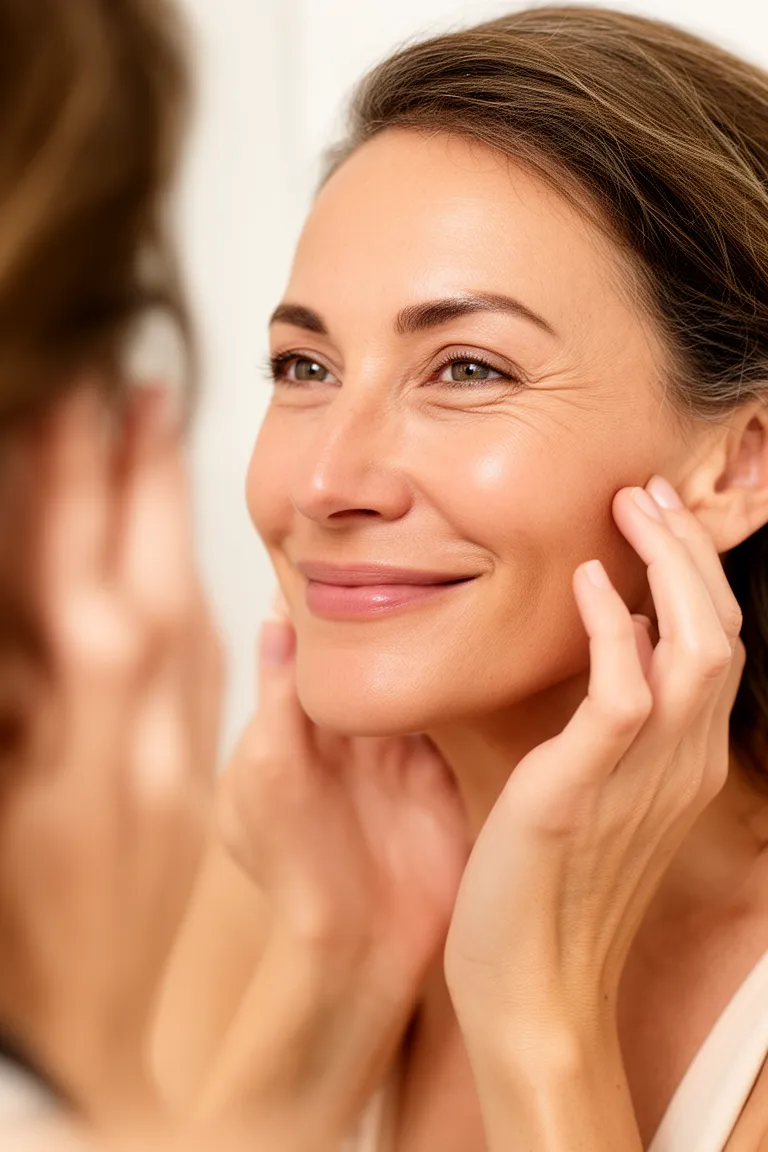
I was patting on my moisturizer one morning, the same gentle, hydrating one I’d used for years, when I saw it. It wasn’t a new wrinkle or a sudden sunspot. It was the skin on my neck. When I turned my head, it didn’t snap back with its usual resilience. Instead, it seemed to linger, folding into a soft, crepey texture I’d never noticed before. I was 44. I felt a hot wave of something between panic and profound unfairness. I did everything right. I ate my greens, drank my water, slathered on SPF 50 like it was my religion, and avoided smoking and excessive sunbathing my entire adult life. So why was my skin losing its fight?
For weeks, I’d catch my reflection and that subtle sagging, that loss of “bounce,” would whisper a taunt. It felt like a betrayal by my own body. I’d followed the rules, and the rules were supposed to work. I remember staring at the array of serums and potions on my bathroom shelf—the hyaluronic acid, the vitamin C, the peptide creams—and feeling a deep frustration. I was checking all the boxes, yet my skin’s elasticity after 40 was quietly slipping away. That moment of recognition sparked a two-year journey to understand what was really happening beneath the surface, and what I could actually do about it.
The Morning I Realized My Skin Had Lost Its Bounce
That moment in the mirror wasn’t about vanity; it was about identity. I still felt energetic and strong, but my reflection was starting to tell a different, older story. I learned that elasticity isn’t just about looking young—it’s about skin health. It’s the combination of collagen, the structural scaffolding, and elastin, the tiny coils that allow skin to stretch and recoil, all housed in the dermis. For decades, I thought sunscreen and a good diet were my golden tickets. What I didn’t grasp was the silent, cumulative toll of time and, yes, even that incidental UV exposure I got walking to my car or sitting by a window.
The shift can feel sudden, but it’s been decades in the making. Around our mid-20s, we start losing about 1% of our collagen per year. Hormonal shifts, especially in perimenopause, can accelerate this process dramatically. So one day, the reservoir just dips below a visible threshold. It’s like a slow leak in a tire you’ve been diligently topping up—eventually, it goes flat. I also learned that noticing significant laxity or a rapid change in texture is a valid reason to book a visit with a dermatologist. It’s not just cosmetic; it’s about ruling out other health factors and getting a professional baseline. For me, that visit was the first step out of frustration and into strategy.
Why Normal Aging and Accumulated UV Exposure Can Appear Suddenly
I used to think aging skin was a linear, predictable process. But my dermatologist explained it more like a bank account. For years, I was making decent deposits with my sunscreen and antioxidants, but I was also making small, steady withdrawals—those five minutes in the car without sunglasses, the years of high-sugar diets in my 30s, the gradual hormonal decline. I hit my 40s and my collagen balance hit zero. The “sudden” sagging was just the moment my skin’s structural savings ran out.
When Laxity Warrants a Professional Opinion
I almost didn’t go to the dermatologist, chalking it up to vanity. But I’m so glad I did. She reassured me that what I was seeing was common, but more importantly, she ruled out any underlying issues that could mimic normal aging. If you’re seeing very rapid changes, asymmetry, or skin that feels unusually thin or bruised, a professional visit isn’t a luxury—it’s a necessary step for your health. It gave me peace of mind and a clear starting point.
Why My Expensive Firming Creams Could Not Do What They Promised
Armed with concern, I did what many of us do: I went shopping. I bought creams with luxurious textures and bold claims about “lifting” and “re-densifying.” I’d apply them faithfully, feel a temporary tightness or see a slight plumping from hydration, and think, “This is it!” But by noon, my skin would settle back into its new, slightly looser normal. I was confusing temporary hydration with structural collagen change. Moisturizers, hyaluronic acid, and even many peptides are fantastic for supporting the skin barrier and drawing water into the surface, which can minimize the appearance of fine lines and make skin look dewy. But they are mostly surface-level players.
The real disappointment came when I scrutinized the claims on my jar of “collagen-boosting” cream. Topical collagen molecules are simply too large to penetrate the skin’s barrier and become part of your dermal structure. They can be good humectants, but they’re not rebuilding your scaffolding. Vitamin C is a powerhouse for protecting existing collagen from free radical damage and is a crucial part of any routine, but it’s a defender, not a construction crew. This was my pivotal realization: I was treating the symptoms of lost elasticity (dryness, fine lines) but not addressing the root cause (the degraded collagen and elastin network). My experience trying everything to restore skin elasticity after 40 was hitting a wall because I was using the wrong tools.
Temporary Hydration Versus Structural Collagen Change
Think of your skin like a mattress. Hydrating ingredients are like a fluffy, soft mattress topper—they make the surface more comfortable and smooth out some lumps. But if the springs inside the mattress (your collagen and elastin) are worn out and sagging, no topper in the world will fix the underlying droop. My expensive creams were just fancy toppers.
What Topical Ingredients Can Realistically Do
This isn’t to say topicals are useless. A strong barrier, maintained by ceramides and cholesterol, is essential for healthy skin function. Vitamin C shields your existing collagen. Peptides can send gentle signals to your skin cells. But none of them, on their own, are a bulldozer that will rebuild a collapsed structure. Understanding this saved me thousands of dollars and months of false hope. am I wasting money on natural anti-aging products.
What Actually Works: Protecting the Collagen You Have Left
My dermatologist framed it beautifully: “You can’t fill a bathtub with the drain wide open.” My first job wasn’t to add more collagen; it was to stop the leak. I thought my daily sunscreen was my shield, and it was, but I needed to upgrade my thinking. She stressed that broad-spectrum protection (guarding against both UVA, which ages, and UVB, which burns) was non-negotiable, every single day, rain or shine. This was my most powerful weapon to prevent further breakdown. Functional integrity of aging skin, from cutaneous biology to anti-aging...
But protection is more than sunscreen. It’s also about defending against internal and environmental stressors—a concept often glossed over. I started paying attention to things like chronic stress, poor sleep, and sugar intake. High blood sugar can lead to a process called glycation, where sugar molecules attach to collagen fibers, making them stiff and brittle. So my healthy diet needed a tweak—less processed sugar, more antioxidants from berries and leafy greens to combat inflammation. This holistic view of “protection” was the missing link in my routine. I was wearing sunscreen every day but my skin was losing elasticity after 40 because I wasn’t protecting it on all fronts.
The Skin-Elasticity Routine I Built After 40
This wasn’t about adding ten new steps; it was about strategic, consistent actions. I simplified dramatically. My morning routine became gentle: a lukewarm water rinse or a mild cleanser, a moisturizer packed with ceramides to reinforce my skin barrier, a vitamin C serum for antioxidant protection, and my holy grail—a mineral-based, broad-spectrum SPF 30 or higher. That’s it. The goal was defense and support.
The evening was where the real renewal work happened, but slowly. On my dermatologist’s advice, I introduced a retinoid. Not aggressively, but gradually. I started with a low concentration over-the-counter retinol, applying it once a week over my moisturizer to buffer it. Over months, I built up tolerance. Retinoids are one of the few topicals clinically proven to signal your skin to produce new collagen and speed up cell turnover. But they are a marathon, not a sprint. The rest of my evening was about recovery: a gentle double cleanse to remove sunscreen, my retinoid (on allotted nights), and a rich, reparative moisturizer. I also looked at lifestyle: prioritizing 7-8 hours of sleep, ensuring I ate enough protein (the building block of collagen), and managing stress with walks instead of wine. This was the best skincare routine to restore skin elasticity after 40 I could design—patient, protective, and proven.
How to Adjust for Sensitive Skin, Rosacea, or Menopause
My skin can be reactive, so I had to move slower than most guides suggested. If you have sensitivity or conditions like rosacea, the “buffering” method (applying retinoid over moisturizer) is your best friend. There are also gentler retinoid alternatives. For menopausal skin that’s often drier, I learned that a richer moisturizer at night was non-negotiable—plumping from hydration makes a huge difference in how crepey skin looks, even if it’s not rebuilding collagen.
The Supplement Question: Are They Worth It?
Seeing “collagen peptides” on every wellness blog, I had to ask. Were collagen supplements worth it for skin elasticity after 40? The science is promising but nuanced. Unlike topical collagen, ingested collagen is broken down into amino acids and peptides that may act as messengers, telling your fibroblast cells to get to work. Some good studies show improvements in skin hydration, elasticity, and collagen density. I decided to try a high-quality, hydrolyzed collagen peptide powder. best stretch mark removal cream that works.
I mixed it into my morning coffee for six months. Did it transform me? No. But I believe it contributed to the overall improvement, like one piece of a large puzzle. My nails felt stronger, and my skin seemed to heal from minor irritations faster. My takeaway is this: don’t expect miracles from a jar of powder, but if your budget allows, it can be a supportive piece of a broader strategy. The key is to pair it with everything else—the protein in your diet, the vitamin C for synthesis, and the topical routine. It’s not a standalone solution.
Scientific Evidence
When Should Skin Elasticity Start Looking Better?
This was the hardest lesson in patience. After a lifetime of quick-fix marketing, I had to reset my expectations. Hydration from a good moisturizer can make skin look plumper in days. Texture from retinoids might improve in 4-8 weeks. But for true improvements in laxity and firmness—the kind that comes from rebuilding collagen—you’re looking at a minimum of 3-6 months of consistent retinoid use, and often more like 6-12 months to see visible lifting.
For more significant changes, people turn to professional treatments. Microneedling and certain lasers can create controlled micro-injuries that trigger a robust healing and collagen-building response. Radiofrequency treatments heat the deeper dermis to tighten existing collagen and stimulate new production. These offer more dramatic results than topicals alone, but they also come with higher cost, downtime, and the need for multiple sessions. They are accelerators, but they still require the same foundational care (sunscreen!). Understanding these timelines saved me from giving up on my retinoid at the two-month mark when I “didn’t see anything.” firming skin treatment for women over 40 that actually works.
| Approach | Best For | Realistic Timeline for Visible Change | Key Consideration |
|---|---|---|---|
| Topical-Only (Sunscreen, Moisturizer, Retinoid) | Early signs, prevention-focused, or budget-conscious | 6–12 months for firmness | Consistency is everything. Works gradually but is sustainable long-term. |
| Topical + Lifestyle & Supplement Support | Those noticing definite laxity who want a holistic push | 4–9 months for overall improvement | Addresses internal and external factors. Requires dietary/sleep adjustments. |
| Topical + In-Office Procedures (e.g., Microneedling, RF) | Moderate sagging where topicals feel insufficient | 1–3 months post-treatment series | Higher cost and downtime. Best for specific, targeted areas like jawline or neck. |
| Surgical Intervention | Significant, structural laxity not responsive to other methods | Immediate, with final results in months | Major decision with longer recovery. A last resort after exhausting other options. |
What I Would Do Differently If I Started Again
If I could go back to that woman staring worriedly at her neck, I’d give her a hug and this advice. First, add one active ingredient at a time. I’d start with a consistent sunscreen and a solid moisturizer. Then, after a month, slowly introduce a vitamin C serum in the morning. Only after that felt normal would I begin the slow, patient journey with a retinoid. This prevents overwhelming your skin barrier, which can lead to irritation, redness, and setbacks.
Second, I would track progress with monthly photos in consistent, natural light. In the day-to-day, it’s easy to feel like nothing is changing. Comparing photos over 4-6 months reveals the subtle shifts. Third, I would ask more questions earlier. If you’re considering an in-office procedure, ask about the clinician’s experience with your specific skin concern, see before-and-after photos of actual patients (not stock images), and understand the full scope of downtime and potential risks. Finally, I’d tell myself that improving sagging skin after 40 when sunscreen and moisturizer aren’t enough isn’t a failure—it’s biology. And biology responds to consistent, intelligent pressure over time, not to frantic product-hopping.
How to Track Progress Beyond the Mirror
I started a note in my phone. Every month, I’d jot down not just how my skin looked, but how it felt. Did it recover from a minor irritation faster? Did my makeup sit better? Was the crepey texture slightly less pronounced under certain light? These subtle wins kept me motivated during the long plateau phases where nothing seemed to happen.
The Biggest Shift: From Fixing to Nurturing
The most profound change in my journey wasn’t in my skin; it was in my mindset. I stopped looking for a product to “fix” my skin and started building a routine to nurture and protect it. The goal shifted from reversing time to cultivating the healthiest, most resilient skin possible for my age. That loss of bounce was a messenger, not a sentence. It told me to level up my protection, to be patient with proven ingredients, and to extend the same grace to my changing body that I’d give to a dear friend.
Today, my skin isn’t the same as it was at 30, and that’s okay. But it’s brighter, firmer, and more even-toned than it was at 44. The crepey texture on my neck has improved significantly. The journey to restore skin elasticity after 40 naturally and effectively is ongoing, but now I walk it with confidence, not panic. I have a plan I trust, and the results, though gradual, are real.
Frequently Asked Questions
Q: How long does it really take to see improvement in skin elasticity with a new routine? A: It’s crucial to manage expectations. You may see improved hydration and brightness within weeks. For noticeable changes in firmness and laxity from ingredients like retinoids, plan on a minimum of 3-6 months of absolutely consistent use. Significant collagen remodeling takes time, so patience and consistency are your most important products.
Q: I have sensitive skin/rosacea. Can I still use retinoids to improve elasticity? A: Yes, but with extreme caution and likely under a dermatologist’s guidance. Starting with a low-concentration retinol applied over your moisturizer (“buffering”) once a week is key. There are also gentler alternatives like bakuchiol, a plant-derived ingredient with similar collagen-stimulating mechanisms that may be better tolerated. Always patch test and introduce any active slowly.
Q: Are collagen supplements worth the money? A: They can be a supportive piece of the puzzle. Look for hydrolyzed collagen peptides (Types I & III are most common for skin) from a reputable brand that emphasizes purity and third-party testing. Remember, they work best in conjunction with a diet rich in vitamin C (which is necessary for collagen synthesis), adequate protein, and a solid topical routine—not as a magic bullet.
Q: What’s the one thing I should start doing today if I’m concerned about laxity? A: Without a doubt, commit to daily, broad-spectrum sunscreen (SPF 30 or higher). It is the single most effective way to prevent further collagen degradation from UV rays. If you already do that, then the next step is to introduce a barrier-supporting moisturizer with ingredients like ceramides and niacinamide to keep your skin healthy and resilient as you consider adding active treatments.
Q: When should I consider professional treatments instead of just topical products? A: If you’ve been consistent with a high-quality topical routine (including sunscreen and a retinoid) for over a year and are still dissatisfied with the level of sagging or laxity, it may be time to consult a board-certified dermatologist or plastic surgeon. Professional treatments like radiofrequency microneedling or laser resurfacing can reach deeper into the dermis than any cream can and are designed for more significant remodeling.
Q: I eat very healthily. Why is my skin still losing elasticity? A: This was my biggest frustration! A healthy diet is foundational, but it may not be enough to counteract decades of collagen loss and hormonal shifts. Skin elasticity after 40 even though you eat healthy requires a targeted approach—specifically, enough high-quality protein for collagen building blocks, antioxidants to fight inflammation, and the right topical actives to stimulate production. It’s a multi-system issue.
Q: How do I choose a collagen supplement if I decide to try one? A: Look for “hydrolyzed collagen peptides” or “collagen hydrolysate” on the label, which means it’s broken down for easier absorption. Opt for products that are third-party tested for purity and heavy metals. A dose of around 10-15 grams per day is commonly used in studies. And remember, it’s a supplement to a good diet, not a replacement for it.
📌 Love this guide? Save it on Pinterest!
Pin Restore Skin Elasticity After 40: My Honest Journey & What Works in 2026 to your board so you can come back to it later.

