
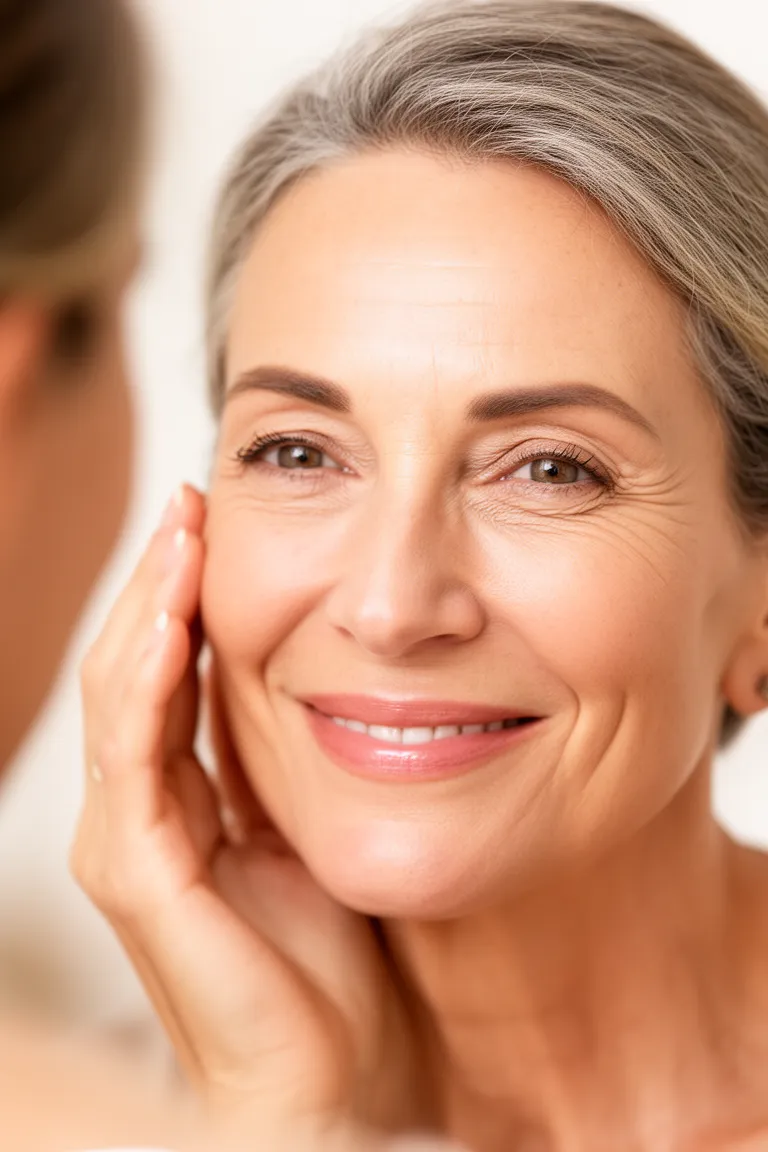
I was standing in front of my bathroom mirror on a bright Tuesday morning, smoothing on my SPF 50 like I had for the past twenty years, when I saw it. It wasn’t a new wrinkle, exactly. It was something subtler, more unsettling. The light from the window caught the line of my jaw, and instead of the clean, firm contour I knew, I saw a faint, soft shadow where my skin seemed to have lost its conviction. My cheeks, which had always been full, looked a little less… resolute. I leaned in. I leaned back. The feeling that washed over me wasn’t vanity—it was pure, unadulterated confusion.
Here’s the thing: I’ve done the work. I’m 47. I lift weights three times a week, I eat my greens and my protein, I drink water like it’s my job, and I haven’t skipped sunscreen since my twenties. I’d earned my laugh lines, but this felt different. This was a quiet deflation, a softening of the architecture. I’d followed all the rules, so why was my skin betraying the script? I felt a pang of something between frustration and unfairness. Wasn’t the healthy lifestyle supposed to be the shield?
That morning was my turning point. It launched me on a quest that was less about chasing a miracle and more about understanding the quiet rebellion happening in my own skin. I spent a small fortune on firming creams that promised a “lift” and collagen drinks that swore they’d rebuild from within. The results were so subtle I wondered if I was imagining them. It turns out, restoring skin elasticity after 40 isn’t about finding one magic potion. It’s a slower, smarter game of protecting what you have, strategically supporting what’s left, and managing expectations with a heavy dose of self-compassion.
The Morning I Realized My Healthy Routine Wasn’t Stopping Skin Sagging
That moment at the mirror forced me to confront a truth I’d been avoiding: prevention and restoration are two completely different battles. My healthy habits were my frontline defense, and they had served me incredibly well. But they couldn’t stop time, genetics, or the cumulative effects of simply living a life. I started to learn that healthy habits cannot fully prevent age-related elasticity loss, and that was a hard pill to swallow. It felt like a personal failure, but it was just biology.
I began studying my reflection with a detective’s eye, trying to understand what I was really seeing. Was it just dehydration making my skin look crepey? Was it morning puffiness subsiding? Or was it genuine laxity—a structural change? Learning how to tell laxity, dehydration, crepey texture, and temporary puffiness apart became my first real lesson. Dehydration plumps back up with a good moisturizer. Laxity, that gentle droop along the jawline and cheeks, doesn’t bounce back after a glass of water. That was my clue. I wasn’t just dry; my skin’s scaffolding was undergoing a quiet renovation I hadn’t approved.
I also had to ask myself a tougher question: were the changes normal, or a sign of something else? I learned that when sudden or asymmetric changes warrant medical assessment. If one side of your face suddenly looks dramatically different, or if you notice rapid thinning, it’s time to see a doctor. For me, it was a symmetrical, gradual softening—the universal whisper of time, not a medical alarm bell. Recognizing that distinction helped me move from worry to strategy.
What Actually Changes in Skin Elasticity After 40
My frustration led me down a rabbit hole of research, and what I found was oddly comforting. It wasn’t that I was doing anything wrong; it was that my body was following a perfectly normal, if inconvenient, script. The central characters in this drama are collagen and elastin—the protein fibers that act like the springs and scaffolding of our skin. After 40, our bodies produce less of them, and the quality of what we have degrades. Think of a brand-new elastic band versus one that’s been in a drawer for a decade. That’s the collagen and elastin decline with age.
But there’s more. Even with my religious sunscreen use, I had to face the reality of cumulative UV exposure and photoaging. The sun damage from my teenage years and twenties, however minimal I thought it was, was presenting its bill. Sunscreen prevents new damage, but it doesn’t erase the past. Every beach day, every drive with the window down, had contributed to a slow-motion breakdown of my skin’s support system. Functional integrity of aging skin, from cutaneous biology to anti-aging...
Furthermore, as a woman in my late 40s, I couldn’t ignore the elephant in the room: hormones. The shifts in menopause, estrogen changes, and increasing dryness play a massive role. Estrogen helps keep skin thick, hydrated, and collagen-rich. As it dips, skin can become thinner, drier, and yes, less elastic. My disciplined lifestyle was mitigating the damage, but it couldn’t override these fundamental biological shifts. I also had to understand the skin barrier, hydration, and why skin can look temporarily plumper. A strong barrier holds in moisture, making skin look fuller and smoother. But that’s a surface-level plumpness, different from the deep structural firmness provided by collagen. I realized I might be mistaking a compromised barrier for lost elasticity.
The Firming Creams and Collagen Products I Nearly Gave Up On
Armed with this knowledge, I went shopping. This was my “throw money at the problem” phase. I bought the expensive jar that promised a “non-surgical lift” and the trendy collagen peptides powder. I used them diligently, waiting for the transformation. Months later, staring at my still-soft jawline, I asked myself: am I wasting money on firming creams after 40?
The experience taught me to read between the lines of marketing. I learned the difference between a product that temporarily plumps the skin with hydration (like a good hyaluronic acid serum) and one that claims to rebuild structure. Most creams fall into the first category—they make skin look better by improving texture and hydration, which is valuable, but they don’t mechanically tighten. This is why moisturizers improve appearance without mechanically tightening loose skin.
Retinol versus prescription tretinoin: evidence, irritation, and realistic timelines
I also dove into the world of retinol versus prescription tretinoin. Retinol, available over-the-counter, is a gentler precursor that can boost collagen over time, but its effects are modest. Prescription-strength retinoids like tretinoin have decades of robust evidence for stimulating collagen, but they come with a potential price of irritation and peeling. I realized I’d been using a weak retinol serum inconsistently for fear of redness, which meant I was likely getting none of the potential benefits. I was terrified of the “retinoid uglies” phase, so I’d quit before I even started.
Peptides, vitamin C, niacinamide, and hyaluronic acid: what each can and cannot do
Then there’s the alphabet soup of other ingredients. Peptides, vitamin C, niacinamide, and hyaluronic acid: what each can and cannot do became my new study topic. Peptides are like little messengers that tell your skin to make more collagen—a supportive role, not a direct builder. Vitamin C is a powerful antioxidant that protects existing collagen from damage and helps make new collagen, but it’s notoriously unstable. Niacinamide strengthens the skin barrier, which helps everything else work better and can improve elasticity. Hyaluronic acid is a hydration superstar, pulling water into the skin for a plumper look. None of them work overnight, and none work in isolation. honest review of collagen boosting skincare products that didn’t work for me.
Oral collagen supplements: promising findings, limitations, and product uncertainty
And the collagen drinks? The science on oral collagen supplements is actually promising, showing they can increase skin density and hydration. But the market is a minefield of varying doses and qualities. I learned that consistency and choosing a hydrolyzed collagen with a decent dose were key, but it wasn’t a standalone fix. It was one piece of a much larger puzzle. The question, does collagen help restore skin elasticity after 40, has a nuanced answer: it can support it, but it won’t single-handedly reverse sagging.
Building a Routine That Supports Structure, Not Just Hype
I stepped back, overwhelmed by products and promises. I decided to strip it all down and build a routine based on evidence and gentleness, not hype. The goal shifted from “restoring” my 25-year-old skin to making my 47-year-old skin look and feel its most resilient and healthy. This became my best routine for restoring skin elasticity after 40.
Morning sequence: gentle cleanse, antioxidant if tolerated, moisturizer, and broad-spectrum SPF
My morning sequence became non-negotiable. I swapped my foaming cleanser for a gentle, non-stripping cream or even just a splash of water. I added a vitamin C serum, understanding its role as a protective shield for my collagen throughout the day. Then, a simple moisturizer focused on barrier support, and my holy grail—a broad-spectrum SPF 50, reapplied if I was outside. I finally understood that sunscreen is the single most effective way to prevent further loss of skin elasticity after 40. Every day without it was undoing any potential progress.
Evening sequence: cleanse, gradual retinoid use, and barrier-supporting moisturizer
The evening was where I got strategic. After a thorough but gentle cleanse to remove sunscreen, I committed to a gradual retinoid. I started with a low-concentration retinol twice a week, applying it to completely dry skin to minimize irritation. On the other nights, I’d rotate: one night for a peptide serum, another for niacinamide. Every single night, without fail, I sealed it all in with a rich, barrier-supporting moisturizer. The mantra was: stimulate, support, and protect—without stripping or irritating. How to introduce one active at a time and manage irritation was the most crucial skill I learned. I gave each new product at least two weeks before adding another, listening to my skin like it was talking to me. what to do when collagen skincare products aren’t working on my face.
Nutrition, protein, sleep, smoking, alcohol, and sun-protective clothing
I already ate well, but I started eating with intention for my skin. I focused on adequate high-quality protein (the building blocks of collagen), vitamin C-rich foods (berries, bell peppers), and omega-3s (for skin lipid support). I looked at my lifestyle: Was I getting enough sleep for repair? Was my stress managed? I cut back on alcohol, which dehydrates and inflames. I even started wearing a wide-brimmed hat for school pick-up. This wasn’t a punitive diet; it was recognizing that my skin is the last organ to receive nutrients from what I eat. If I wasn’t feeding it properly, no cream could compensate.
This holistic approach—the consistent topical routine paired with supportive lifestyle habits—is what finally made a visible difference. My skin didn’t “snap back.” But after about three months, it looked thicker, more even, and had a renewed firmness. The shadow along my jaw was less pronounced. It had a better bounce. I was improving sagging skin after 40 by giving it the consistent, multi-pronged support it actually needed.
Understanding Your Pathway: From Foundation to Professional Support
Through my trial and error, I saw that people approach restoring skin elasticity after 40 from different starting points and with different goals. What worked for me might be overkill for someone else, or not enough for another. To help make sense of the options, I thought about it in terms of pathways.
| Approach | Best For | Realistic Timeline for Visible Change | Key Consideration |
|---|---|---|---|
| The Lifestyle & Prevention Foundation | Those new to skincare or wanting to maximize prevention. Focuses on SPF, diet, hydration, sleep. | 12+ weeks for subtle improvements in overall glow and texture. | Essential for everyone, but may not address existing laxity on its own. It’s the non-negotiable base. |
| The Consistent Topical Routine | Anyone ready to commit to daily actives like retinoids, vitamin C, and peptides to support collagen. | 8-12 weeks for improved texture; 4-6 months for noticeable firmness. | Requires patience and managing irritation. This is where most at-home “restoration” happens. |
| The Combined Inside-Out Approach | Those, like me, who saw limited results from topicals alone and want to add internal support. | May accelerate results from the topical routine, with better hydration and skin density in 6-8 weeks. | Involves targeted nutrition, possible supplements, and stress management. It’s holistic but requires more daily intention. |
| The Professional Guidance Path | For significant laxity or when home care hits a plateau. Involves dermatologist consultations for in-office procedures. | Varies by treatment; some require multiple sessions and months of collagen rebuilding. | An investment in time and money. Not a replacement for a good home routine, but a powerful adjunct. |
Seeing it laid out like this helped me understand I was trying to jump straight to a “Combined” approach without nailing the “Consistent Topical” foundation first. I had to walk before I could run.
Scientific Evidence
When Home Care Isn’t Enough—and What I’d Consider Next
I’m a realist. I know that topical products and lifestyle have a ceiling. They can significantly improve skin quality, resilience, and firmness, but they cannot redrape significantly loose skin. For me, this is about managing expectations. What improvement may look like after 8 to 12 weeks and 3 to 6 months is better texture, enhanced firmness, and a brighter complexion—not a lifted jawline. My experience restoring skin elasticity after 40 taught me that “improvement” means your skin looks the best it can for your age, not that it reverts to a former version.
So, I’ve started to research the in-office options with a clear head, which is part of when home care isn’t enough. If I decide to go further, I’ll consult a board-certified dermatologist. I’m curious about dermatologist options: laser, microneedling, radiofrequency, peels, and surgery. Treatments like radiofrequency microneedling can heat the deeper layers of skin to stimulate a more robust collagen response than topicals can achieve. But I’ve also learned about the risks, contraindications, skin-of-color considerations, and menopause-related decisions. Not every treatment is right for every person or skin tone, and hormonal status can affect healing. I tried natural wrinkle remedies and they didn’t work.
These are investments with downtime and risks, and they’re not about reversing age. They’re about turning the dial forward on firmness within the realistic framework of my 40-something skin. I now have a list of questions to ask before choosing an in-office treatment: What’s the evidence for this on skin like mine? What’s the full recovery like? What’s the worst-case side effect? Knowing this empowers me. I’m no longer wasting money on magic beans; I’m making informed choices, starting with the foundation I can control every single day.
The Mindset Shift That Made All the Difference
The biggest change wasn’t in my medicine cabinet; it was in my head. I stopped asking, “Why isn’t my skin elasticity improving after 40?” with a tone of betrayal. I started asking, “How can I best support my skin right now?” This shifted me from a battle against my reflection to a partnership with my body. Some days, my skin looks tired and softer. Other days, it looks plump and radiant. I’ve learned that consistency is the true miracle ingredient, and self-compassion is the best serum. The journey of how to restore skin elasticity after 40 is ultimately about embracing a new kind of resilience—one that’s less about perfection and more about loving, informed care.
Frequently Asked Questions

Q: How long does it take to see real results when trying to improve skin elasticity? A: Patience is non-negotiable. Skin regenerates on a cycle of about 28 days, but rebuilding collagen is a slow process. You might see improvements in hydration and texture within 4-6 weeks. For noticeable changes in firmness and elasticity, you need to commit to a consistent routine for a minimum of 3 months, with more significant results often appearing at the 6-month mark. There are no quick fixes, which is why so many people give up too soon.
Q: Is retinol worth it for skin elasticity after 40, and how do I start without irritating my skin? A: Yes, retinoids (including retinol) are considered the gold standard in topical anti-aging for their proven ability to boost collagen production. The key is to start low and slow. Begin with an over-the-counter retinol (0.25% or 0.5%) just one night a week for two weeks, then slowly increase to two nights, then three. Always apply it to dry skin, followed by a moisturizer. If irritation occurs, scale back. Consistency with a gentle approach beats aggressive use that wrecks your skin barrier. It’s a marathon, not a sprint.
Q: Does collagen help restore skin elasticity after 40, and what should I look for in a supplement? A: The research on oral collagen peptides is promising, showing benefits for skin hydration, density, and elasticity. It’s not a miracle, but it can be a helpful supportive tool. Look for a hydrolyzed collagen (type I and III are best for skin) from a reputable brand that discloses its dose (studies often use 2.5-10 grams daily). Ensure it’s third-party tested for purity. Remember, it’s a supplement to a good diet and skincare routine, not a replacement. Think of it as giving your body the specific building blocks, but you still need the rest of the construction crew (like Vitamin C) to use them.
Q: I eat healthy and wear sunscreen but still see changes. Why isn’t my skin elasticity improving? A: This was my exact frustration, the core of my skin elasticity after 40 even though I eat healthy dilemma. First, validate that you’re comparing prevention to restoration—sunscreen prevents future damage but doesn’t reverse past damage. Second, review your routine: are you using proven actives like retinoids or peptides consistently? Is your skin barrier healthy, or are you over-cleansing? Finally, consider internal factors like perimenopause/hormonal shifts, which can accelerate collagen loss independently of lifestyle. A holistic approach targeting both internal health and a strategic topical routine is essential.
Q: Can sunscreen alone prevent loss of skin elasticity? A: Sunscreen is your most powerful weapon for prevention. It shields the existing collagen and elastin in your skin from UV rays that break them down. However, it cannot stop the intrinsic aging process driven by genetics and hormones. Think of sunscreen as the ultimate protective shield—it will dramatically slow down the rate of elasticity loss caused by the sun, which is a major contributor, but it works best as part of a comprehensive strategy that includes collagen-supporting actives and healthy lifestyle habits. It’s the most important single product, but it’s not a solo act.
📌 Love this guide? Save it on Pinterest!
Pin Restore Skin Elasticity After 40: My Honest Journey & Proven Tips 2026 to your board so you can come back to it later.

